Salik, Dubai's toll road system, charges for gate crossings automatically, with no barrier and no stopping. On a rental car it works a little differently than on your own: the tag is linked to the car, not to you personally, and the question of who actually pays and when confuses most renters. Here are the facts as they stand in September 2026.
How Salik physically works
Dubai has 10 Salik gates on the main highways and interchanges. The sensor in the car is read at driving speed, no barrier and no stopping required. The rate depends on the time of day: during peak hours, 6:00 to 10:00 and 16:00 to 20:00 on weekdays and Saturdays, a crossing costs AED 6.30. At other times on weekdays and Saturdays it is AED 4.20. At night, from 1:00 to 6:00, crossings are free. Sundays run on a separate rule: a flat AED 4.20 all day, with no peak/off-peak split. Both rates already include the 5 percent VAT that has applied since 1 June 2026.
| When | Rate, AED |
|---|---|
| Mon-Sat, 6:00-10:00 and 16:00-20:00 (peak) | 6.30 |
| Mon-Sat, other hours | 4.20 |
| Sunday, all day | 4.20 |
| Night, 1:00-6:00, any day | free |
Who pays Salik on a rental car
The Salik tag is physically built into the car and linked to its plate, not to the driver. The charge is deducted from the transponder account that the rental company manages, not from you directly at the moment you cross a gate. In practice this means you do not think about Salik while you drive, the gate simply charges the car's account, exactly as it would if the car were your own.
The company then passes that amount on to you, the renter, based on the gates actually crossed during your rental. This is standard practice across the whole Dubai market, not a quirk of any one company: whoever was using the car at the time pays for that crossing.
When you actually get billed
Salik charges are not instant: the system processes and forwards crossing data with a delay, usually days rather than minutes. Because of that, the final total for all your crossings during a rental is not known right when you return the car, it becomes clear a bit later once every crossing has worked its way through the system. The practical takeaway: if you have already returned the car and left Dubai, a Salik charge can still arrive after you are gone. That is normal and does not mean anyone is trying to bill you unfairly after the fact.
How we handle it
We do not take a deposit against possible crossings and we do not estimate a number. The invoice is built from actual Salik data: how many times the car crossed a gate during your rental, at what time of day, and at which rate. You can ask for a breakdown by date and gate if you want to check it against your own route. We do not add any markup on top of the official Salik rate.
If you mostly drove at night or on Sundays, the total will be noticeably lower than if every trip fell in weekday peak hours: the gap between AED 4.20 and 6.30 per crossing adds up to AED 15 to 30 over a week of active city driving, worth keeping in mind when timing trips to meetings downtown.
How much this typically adds up to
A visitor driving around Dubai over a week, airport to hotel, a few trips to Dubai Mall or Downtown, maybe a day trip to Abu Dhabi, will usually cross 4 to 10 Salik gates depending on the route and time of day, adding roughly AED 20 to 60 on top of the rental itself. For comparison, a drive from DXB airport to the Marina usually passes one or two gates.
Can you avoid Salik gates
Technically yes, most gates have a parallel road without one, but in practice it is almost always slower and not worth the time saved to dodge AED 4 to 6. The gates sit on the busiest stretches, like Sheikh Zayed Road and the bridges over the Creek, for a reason: those are the fastest routes across the city.
Common questions about Salik on a rental car
Is Salik deducted from a deposit? We do not hold a deposit, so it is billed separately based on actual crossings. Do I pay if I never used a particular road? You only pay for the gates you actually crossed, the system bills per crossing, not a flat subscription. What if Salik records an extra crossing by mistake? Send us the date and time and we will check it against the system's own data.
Why these specific hours count as peak
The morning peak from 6:00 to 10:00 and the evening peak from 16:00 to 20:00 line up with the start and end of the Dubai working day, and traffic on the main highways like Sheikh Zayed Road and Al Ain Road genuinely gets heaviest in those windows. The gap between the peak and off-peak rate, AED 6.30 versus 4.20, is small in absolute terms, but if you drive to a meeting every weekday at 8 am and back at 6 pm, it adds AED 20 to 30 over a week compared with leaving an hour earlier or later.
Driving beyond Dubai: Salik and Darb are separate systems
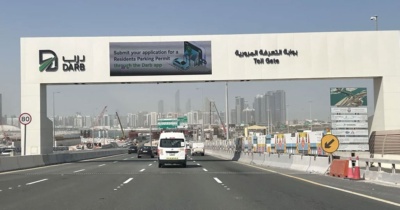
Salik only operates in Dubai. Drive a rental car to Abu Dhabi and you enter the territory of Darb, that emirate's own toll bridge system. It is structured and priced independently of Salik. The physical tag in the car is the same one, but charges follow the rules of whichever emirate you are driving through. Salik has no separate weekend rate beyond its Sunday rule, while Darb treats Saturday as a normal paid day and only Sundays and public holidays are free. A full breakdown of Darb rates is covered in our separate guide to Abu Dhabi toll roads. For Salik, the one thing worth remembering is that the two systems are independent, and their charges are billed and calculated separately.
Example: a day of driving around Dubai
A typical visitor's day: leaving a Marina hotel at 9:00 am (peak hour, one gate on Sheikh Zayed Road, AED 6.30), lunch downtown and driving back at 7:00 pm (peak again, another gate, AED 6.30). Total AED 12.60 for the day. Shift both trips by an hour, to 10:15 am and 8:15 pm, and the rate drops to AED 4.20 per crossing, AED 8.40 total, a saving of AED 4.20 for the day. Over a week of active driving that gap adds up to AED 25 to 30, not a lot, but a nice bonus if trips are planned a little ahead of time.
Estimating your own Salik costs in advance
The simplest way is to think through your route: count how many times a day you actually cross a major highway or one of the Creek bridges, and multiply by AED 4.20 to 6.30 depending on the time. A renter who mostly stays within one area, say living and working around the Marina, may end up close to zero, there are barely any gates on that kind of route. Someone commuting from Deira to the Marina and back through downtown every day will cross two or three gates a day, which adds up to AED 60 to 100 over a week.