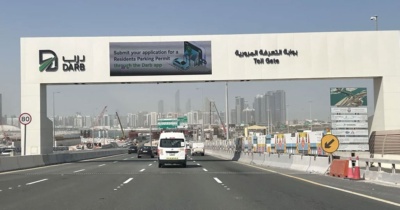
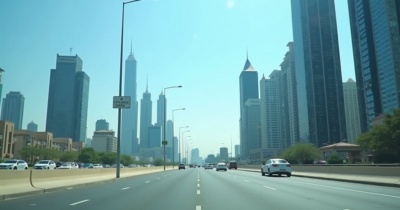
Dubai's traffic is predictable: it follows office hours and the geography of a city stretched sixty kilometres along one highway and the sea. Knowing three things, when, where and what to use instead, you can avoid it almost entirely. This is a key difference from European capitals, where congestion is chaotic.
When
The morning peak runs 7:00 to 9:30 towards the centre and the business districts: north from the Marina, JBR and Jumeirah, south from Sharjah. The evening peak runs 17:00 to 19:30 in the opposite direction. The UAE working week is Monday to Friday, with Saturday and Sunday as the weekend. Thursday evening is the worst: some offices finish at midday on Friday and people head across the emirates early.
Friday midday is a special case: from 12:00 to 14:00 Muslims travel to Friday prayers and the areas around mosques get busy. Sunday is the quietest day, with clear roads throughout. Ramadan shifts everything: congestion builds before sunset as everyone hurries home for iftar, roughly an hour before dusk, and this is the most dangerous hour on the roads all year. During Ramadan daytime the city is nearly empty.
Where
- Sheikh Zayed Road between the Marina and Downtown at peak times in both directions. The country's busiest road, twelve lanes wide and all of them full.
- The Marina and JBR exits in the evening: the district is densely built with towers but has only three exits, and at 18:00 getting out takes 20 to 25 minutes.
- The Creek crossings: Al Maktoum, Al Garhoud, Business Bay Crossing and the Al Shindagha tunnel. Deira and Bur Dubai connect to the rest of the city only through these, and in the morning they are a bottleneck.
- The Sharjah road on the E11 and Al Ittihad Road: outbound in the evening, inbound in the morning, with jams of an hour or more. Half of Dubai's workforce lives in Sharjah because of housing costs.
- Approaches to Dubai Mall at weekends and during sales: the ring around the Burj Khalifa stops moving and entering the car park takes fifteen minutes.
- Al Khail Road at the Downtown and Business Bay interchanges in the morning.
- The road onto Palm Jumeirah on Friday and Saturday evenings, the island's only entrance.
- Academic City and school districts from 7:00 to 8:00 and 14:00 to 15:00.
How to avoid it: three parallel highways
Three parallel routes run the length of the city at different distances from the sea: Sheikh Zayed Road E11 along the coast, Al Khail Road E44 three kilometres inland, and Emirates Road E611 further out in the desert. When the E11 is blocked, Al Khail usually flows, and Emirates Road is almost always clear.
A practical example: from the Marina to the airport at peak time via Sheikh Zayed Road takes an hour, via Emirates Road forty minutes, even though the map shows a fifteen-kilometre detour. Your navigation app will usually offer both; trust the time, not the distance.
Around Downtown use Financial Centre Road and Al Asayel Street, which shadow the main avenues. Enter Deira via Al Garhoud Bridge rather than the overloaded Al Maktoum. Leave the Marina via Al Sufouh Road along the coast instead of the main SZR exit.
Navigation apps
Google Maps is accurate on Dubai traffic, knows every multi-level interchange and correctly directs you to the right flyover level, which matters here. Waze is equally good and additionally warns about cameras and mobile patrols marked by drivers. Apple Maps is acceptable. Some regional apps handle interchanges poorly and occasionally suggest exits that do not exist, making them a poor choice for Dubai.
Time-saving tactics
- Shift your departure by thirty minutes: at 6:45 and 9:45 the roads are twice as clear as at 8:00. The same in the evening: 16:30 or 20:00 rather than 18:00.
- Plan routes against the flow: out of the centre southwards in the morning, into the centre from the south in the evening.
- Park at a metro station park-and-ride on the Red Line if your meeting is in Downtown or DIFC in the morning. The car parks are free and the metro runs on its own elevated track with no traffic.
- At weekends head straight for the upper levels of mall car parks rather than circling the lower ones: the same time, far more spaces.
- Use the RTA Dubai app to check road conditions before setting off.
- Plan trips to Abu Dhabi and other emirates for Saturday morning or Sunday, when the highway is empty.
Parking at peak times
Street parking in business districts is almost always full during working hours, and finding a space in Business Bay or DIFC between 9 and 17 is hard. Multi-storey car parks at office towers charge AED 10 to 20 an hour but always have spaces. Residential areas often operate resident permit schemes with no visitor spaces at all.
Is a car worth it with this traffic
Yes, if you are a visitor: your trips do not coincide with office hours, you head to the beach at 10 am and to dinner at 8 pm, when the roads are clear. Congestion is a resident's problem with a fixed schedule. Outside peak hours Dubai moves very fast: end to end across the city in 30 to 40 minutes.
Metro, tram and ferry as a complement to the car
Sometimes the right answer is not choosing between a car and public transport but combining them. In Dubai that works better than you might expect.
Metro: two lines, the Red running along Sheikh Zayed Road from the airport through Downtown to the Marina and Expo City, the Green covering Deira and Bur Dubai. It runs from 5:00 to midnight, and to 1 am on Fridays. A Nol card is bought at any station and a journey costs AED 3 to 7.5. Most Red Line stations have free park-and-ride car parks.
The Dubai Tram: a loop through the Marina and JBR connecting to the metro. Useful if you are staying in the Marina and heading Downtown at rush hour: leave the car at home and take the tram to the metro.
Ferries and abras: water transport across the Creek and around the Marina, more of an experience than transport, although the AED 1 abra across the Creek is the fastest way from Deira to Bur Dubai at rush hour.
The typical pattern: a car for out-of-town trips, beaches and evenings, and the metro for morning business journeys into the centre.
How Dubai's interchanges work
The multi-level interchanges on Sheikh Zayed Road and Al Khail Road confuse newcomers more than the traffic does. The main rules.
Exits are usually on the right, but some interchanges use left-hand exits and signs warn 500 metres ahead. Change lanes early: at 100 km/h crossing four lanes in 200 metres is impossible.
Your navigation app says "keep right" a kilometre in advance because the interchange is long. Take it literally and do not delay.
If you miss an exit, do not brake or reverse, which is dangerous and punishable. Carry on to the next U-turn, usually 2 to 4 kilometres ahead, turn and come back. You lose 5 to 10 minutes.
On flyovers and in tunnels, crossing a solid line is prohibited and enforced by camera.
Congestion by district
| District | Problem | When |
|---|---|---|
| Dubai Marina, JBR | getting out of the district | 17:00–19:30 |
| Downtown, Business Bay | entry and parking | 8:00–9:30, weekend evenings |
| Deira, Bur Dubai | the Creek bridges | 7:30–9:30, 17:00–19:00 |
| Al Barsha, Mall of the Emirates | mall approaches | weekends from 16:00 |
| Palm Jumeirah | the single entrance | Friday and Saturday evenings |
| The Sharjah border | commuter flow | 7:00–9:00, 17:00–20:00 |
| Academic City | schools and universities | 7:00–8:00, 14:00–15:00 |
Parking in residential areas and at hotels
A topic people rarely consider in advance. Most Dubai residential towers have underground car parks with limited spaces, usually one per apartment. If you rent an apartment through Airbnb or a booking site, ask the host whether a parking space is included and how to get the access pass: without it the barrier will not open, and street parking in residential areas is often resident-only.
Hotels usually offer free parking for guests, although five-star properties Downtown and on the Palm sometimes charge AED 30 to 60 for valet retrieval. Check when booking.
Visitor parking in residential complexes is time-limited, usually to four hours, and monitored by security. Overstaying results in a wheel clamp or towing.
What to do when you are stuck in traffic
Dubai jams rarely last longer than forty minutes, but sitting in one in summer means running the air conditioning hard and burning fuel. Practical advice.
Do not keep changing lanes hunting for a faster one: in dense traffic it does not work, raises accident risk, and cutting in is camera-enforced at AED 1,000.
Do not use the hard shoulder even if others do: that is AED 1,000 and 6 black points, and cameras watch the shoulder.
Do not block a junction by entering it in queued traffic: AED 500.
If the jam is caused by an accident ahead, your navigation app will usually offer a parallel-street detour, so trust it.
Keep your phone in a mount and do not pick it up even while stationary with the engine running: cameras record this as an offence.