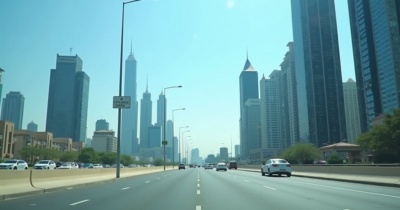
Roads in the Emirates are among the best in the world, which is precisely why they are policed by cameras rather than patrols. On Dubai's highways there is a radar roughly every two kilometres, joined by cameras at traffic lights and cameras that measure following distance, track lane changes and spot a phone in hand. A fine goes onto the plate without anyone stopping you, and on a rental car it reaches us first. Below are the limits, the trigger threshold, the federal table and the way a fine gets to you.
Speed limits
- Residential streets: 40 km/h.
- City roads: 60 to 80 km/h.
- Urban expressways, including Sheikh Zayed Road inside Dubai: 100 km/h.
- Inter-emirate highways: 120 to 140 km/h.
Signs are frequent and the limit changes at interchanges without warning, so read the signs rather than the traffic. Google Maps and Waze show the limit and warn of cameras; switch that on for your first drive.
The 20 km/h tolerance
In every emirate except Abu Dhabi the radar triggers at 20 km/h or more above the limit: with a limit of 100 the fine arrives from 121. Abu Dhabi has no tolerance at all and fines from the first kilometre. The emirate border on the Dubai to Abu Dhabi highway sits at roughly kilometre 60, and the tolerance vanishes without a sign. Driving at plus nineteen is not worth it either: some cameras are calibrated more precisely than drivers expect, and the difference between 119 and 121 is not worth AED 600.
Speeding fines
The table is federal and applies in every emirate. The bands refer to the excess over the posted limit; in Dubai cameras normally start recording at limit +21 km/h.
| Excess | Fine | Black points | In addition |
|---|---|---|---|
| up to 20 km/h | AED 300 | — | |
| 20–30 km/h | AED 600 | — | |
| 30–40 km/h | AED 700 | — | |
| 40–50 km/h | AED 1,000 | 0 | |
| 50–60 km/h | AED 1,500 | 6 | 15-day impound |
| 60–80 km/h | AED 2,000 | 12 | 30-day vehicle impound |
| over 80 km/h | AED 3,000 | 23 | 60-day impound |
Impounding applies to rental cars too: the car is taken from the renter, and the cost of getting it back falls on the renter. A visitor's first fine in Dubai is almost always for speed, and almost always AED 600 for a little over twenty.
Other common fines
| Offence | Fine | Points |
|---|---|---|
| Phone in hand while driving | AED 800 | 4 |
| Seat belt not worn, per person | AED 400 | 4 |
| Running a red light | AED 1,000 | 12, 30-day impound |
| Tailgating | AED 400 | 4 |
| Sudden lane change, cutting in | AED 1,000 | 4 |
| Changing lane without indicating | AED 400 | — |
| Driving slowly in the left lane | AED 400 | — |
| Child without a car seat | AED 400 | 4 |
| Jumping a queue at an exit via the shoulder | AED 1,000 | 6 |
| Driving in a bus lane | AED 600 | — |
| Dirty car | AED 500 | — |
| Loud music | AED 400 | — |
| Littering from the window | AED 1,000 | — |
| Alcohol at the wheel, any amount | from AED 20,000 | arrest, court |
For a visitor on a foreign licence black points accumulate in the UAE system and are not sent home, but at 24 points in a year the car is impounded regardless of whose licence the driver holds.
How a fine reaches you
- A camera records the offence, and within one to fourteen days it appears in the Dubai Police database against the plate.
- We check the database for every car daily and for 30 days after your return.
- If anything has arrived, we send a WhatsApp message with the date, place, amount and the camera photo.
- You can pay yourself on the Dubai Police website or app with a card from any country, or through us. We pass the fine on at the actual amount with no handling fee.
We take no deposit, so nothing is withheld or deducted from a security hold. All fines on a car are publicly visible by plate number, so you can always check the list yourself.
Where the cameras are
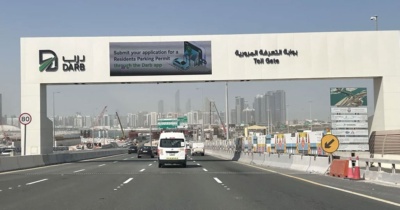
Fixed radars on Sheikh Zayed Road, Al Khail Road, Emirates Road and the Abu Dhabi highway stand on grey poles every two to three kilometres, and navigation apps know almost all of them. On top of those there are cameras at traffic lights, distance cameras on Sheikh Zayed Road, cameras on patrol cars and mobile radars on tripods at the exits of residential areas, which the apps do not know. Lane-control cameras record crossing a solid line and cutting in; you can spot them by the double lens above interchanges. A flash does not always mean a fine: some cameras photograph the traffic for statistics and some check registration and insurance.
Fines in the other emirates
The fine table is federal, but the total can differ: Abu Dhabi adds its own charges on top of the federal fine, and with no tolerance that is where visitors from Dubai collect the most fines. Sharjah is known for traffic-light cameras and low limits inside the city, 60 to 80 km/h on wide roads where you feel like going faster. Ras Al Khaimah and Fujairah have fewer cameras but more patrols on the mountain roads. Fines from any emirate go into a single database and can be seen by plate number through Dubai Police.
If the police stop you
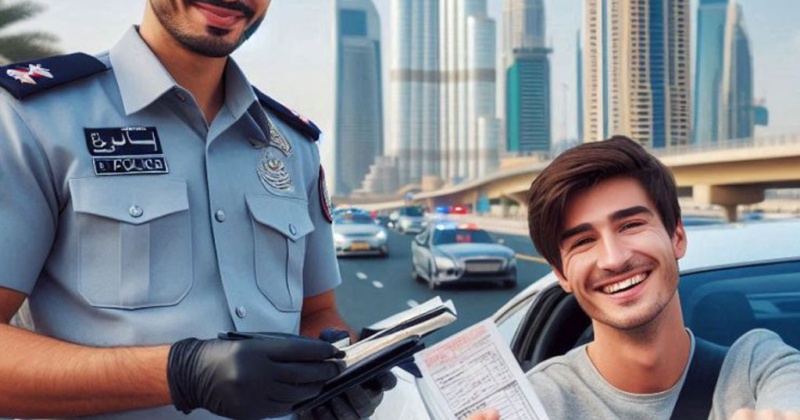
Pull over to the right, stay in the car, lower the window. Have ready your licence, International Driving Permit, passport or a photo of it, the vehicle registration and the rental contract from the glovebox. Officers are polite, speak English and do not take money; offering a bribe means a trip to the station. The check takes five minutes.
How not to collect fines
- Spend the first twenty minutes on quiet streets getting used to the car and the signs.
- Keep to the middle lanes on highways: the left is for the fast, the right is full of exits.
- Phone only in a mount, belts on everyone including rear passengers.
- Do not flash, honk or answer gestures: in the UAE that ends in a police report rather than a fine.
- Wash the car after the desert; a dirty body really is fined.