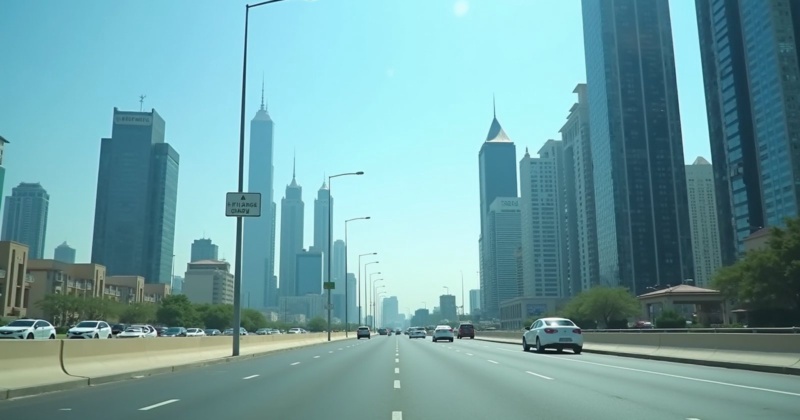
Traffic in the UAE drives on the right, signs follow international standards with Arabic and English text, road markings are crisp and fresh, and interchanges are multi-level. A driver from Europe, India or the Gulf adapts within an hour. The trouble starts not with misunderstanding but with habits that cost money here: overtaking on the right, a phone in hand, cruising in the left lane at the speed of the flow. Below are the rules in the order you will meet them on the road.
Speed
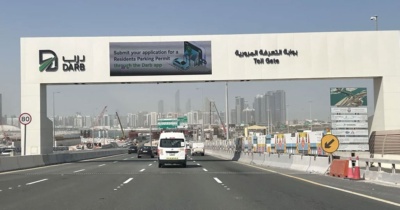
Residential streets 40, city roads 60 to 80 km/h, urban expressways 100, inter-emirate highways 120 to 140. Sheikh Zayed Road is 100 inside Dubai and 120 beyond it; sections of Emirates Road and the Abu Dhabi highway are 140. Signs are frequent and limits change without warning at interchanges, so watch the signs, not the traffic.
Speed cameras trigger at 20 km/h above the limit in every emirate except Abu Dhabi, where you are fined from 1 km/h over and the radars are calibrated precisely. On the Dubai to Abu Dhabi highway the emirate border crosses the road at roughly kilometre 60 and the tolerance vanishes without notice.
Lanes and overtaking
The left lane is for overtaking; driving slowly in it costs AED 400. Overtaking on the right is prohibited, although local drivers do it constantly. Cutting in and sudden lane changes without indicating cost AED 1,000 and 4 black points, and Dubai really does fine this with cameras that track trajectories. Keep your distance: tailgating is AED 400, and Sheikh Zayed Road has cameras that measure it. A U-turn across a solid line is AED 1,000. Driving on the hard shoulder is AED 1,000 and 6 points, and the temptation on the Marina exit at rush hour is real.
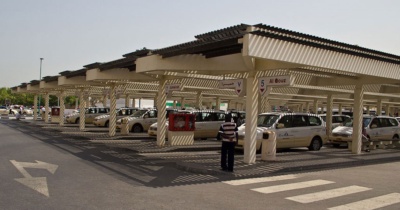
Bus lanes are marked with red asphalt and cost AED 600 to enter. So do the taxi lanes at the airport.
Roundabouts
There are many, especially in Sharjah, Abu Dhabi and older parts of Dubai. Traffic already on the roundabout has priority. Take the right lane for the first exit and the left lane for the second and beyond, and indicate before exiting. Stopping on a roundabout is not allowed. The large roundabouts in Mirdif and Sharjah have traffic lights on the circle itself, which confuses newcomers.
Traffic lights and junctions
Red means red: running one costs AED 1,000, 12 points and a 30-day vehicle impound. At most Dubai junctions amber counts as red if you entered after it came on. Turning right on red is prohibited except where a sign allows it. Left-turn arrows are separate and stay red for a long time.
Pedestrians
At a zebra crossing without lights you must stop; the fine is AED 500 and 6 points. Pedestrians themselves are fined AED 400 for jaywalking, so they rarely step into the road, but in the old town, Deira and around the souks stay alert: people cross anywhere.
Phones, seat belts, children
A phone in hand costs AED 800 and 4 points, and cameras detect it from a photo of the cabin. A dashboard mount and hands-free are allowed. Seat belts are mandatory for everyone including rear passengers, AED 400 per person. Children under 4 must be in a car seat; children under 145 cm and younger than 10 may not sit in the front. Smoking while driving is allowed, but not with a child in the car.
Alcohol
Zero. Not 0.3 per mille, zero. Any amount means a fine from AED 20,000, loss of licence and arrest with a possible custodial sentence. Police check at points outside bar districts and after every accident, minor ones included. If dinner involves wine, leave the car at the hotel and take a taxi or a driver. Residual alcohol from the previous evening counts too.
Parking
Paid from 8 am to 10 pm except Sundays and public holidays, AED 2.10 to 4.20 an hour off-peak, up to AED 6.30 in premium bays at peak, VAT included. Pay through the Parkin app or SMS. Non-payment is AED 150, parking in a prohibited place 200 to 500, in a disabled bay 1,000 and 6 points, on a zebra crossing 500. Towing happens only when you block traffic. More in our separate parking guide.
Fines that surprise visitors
- Dirty car: AED 500. Meant for sand after the desert rather than dust, but the police interpret it their way.
- Loud music with open windows: AED 400.
- Rude gestures at other drivers: arrest and deportation. This is a criminal matter here.
- Flashing headlights to demand the lane: AED 400, even though locals do it all the time.
- Failing to stop for the police: AED 800.
- Entering a junction in a jam and blocking it: AED 500.
- Driving without a plate or with a covered plate: AED 3,000.
- Tinted front windows: AED 1,500. Rear tint up to 50 percent is allowed.
- Throwing litter from the window: AED 1,000.
The police
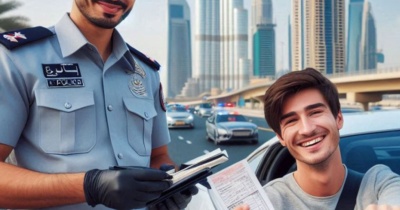
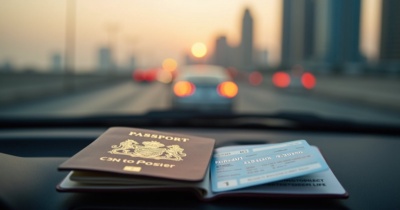
Officers are polite, speak English and do not take bribes; offering one is a criminal offence. When stopped, stay in the car and have ready your licence, IDP, passport, the vehicle registration and the rental contract. Do not get out unless asked. After any accident calling the police is mandatory: without their report the insurer does not pay and the car will not be repaired. Dial 999 for police and ambulance, 901 for non-urgent matters.
Black points
Serious offences carry black points; 24 points in a year means licence suspension. For a visitor on a foreign licence the points are recorded in the UAE system but not transmitted home. For residents on a local licence they are a real threat.
What to do on day one
Drive the first 20 minutes on quiet streets to get used to the car's size and to a left-hand-drive vehicle if you come from a country that drives on the left. Turn on a navigation app with camera alerts. Check the documents are in the glovebox. And stay in the middle lanes on expressways: the left is fast, the right is full of exits and merges.
Local driving culture
The rules in the UAE are strict, but local driving culture differs from European norms and it pays to be ready. The traits that surprise visitors most:
- Aggressive headlight flashing. The driver behind wants the left lane cleared. Technically an offence carrying a AED 400 fine, but everyone does it. The right response is to move right rather than argue.
- Abrupt lane changes without indicating. Especially at interchanges and before exits. Keep more distance than you are used to.
- Overtaking on the right. Prohibited but widely practised. Check your mirrors twice before changing lanes.
- Sudden stops in the right lane. Taxis and delivery vehicles stop wherever suits them.
- Delivery motorcycles between lanes. In heavy traffic they filter between rows, so watch carefully when changing lanes.
The general advice: do not compete and do not react emotionally. Retaliatory aggression in the UAE can end in criminal proceedings, because rude gestures and verbal abuse are prosecuted seriously here.
Petrol stations: how they work
There is no self-service at UAE petrol stations apart from a few new sites. You pull up to the pump, an attendant comes to the car, and you state the fuel type and amount or simply say full tank. You need not leave the car and can pay by card on a handheld terminal or in cash. Tips are not expected but are appreciated.
Fuel grades: Special 95 on the green pump, Super 98 on red, Diesel on yellow. Almost every car in the fleet runs on 95, supercars require 98, and diesel appears only in some SUVs and minivans. The fuel type is stated in the contract and usually on the filler flap. Misfuelling means an expensive repair that insurance does not cover.
The main chains are ENOC and EPPCO in Dubai and ADNOC in Abu Dhabi and the northern emirates. Prices are set by the government, identical nationwide and revised monthly. Most stations have a shop, cafe, restroom and car wash.
Night driving and special conditions
Roads in Dubai are excellently lit at night, but the highways out to Hatta, Al Ain and the east coast have no lighting at all. Camels, goats and feral donkeys appear there, especially near farms. Hitting a camel at 120 km/h is potentially fatal: the animal weighs up to 600 kg and ends up on the windscreen. Reduce speed on these roads at night and use main beam where there is no oncoming traffic.
Fog forms on winter mornings from December to February, particularly in desert areas and on the Abu Dhabi highway. Visibility drops to 20 to 50 metres within minutes. Switch on fog lights and hazards, slow down and never stop on the carriageway. In heavy fog the police close sections of highway.