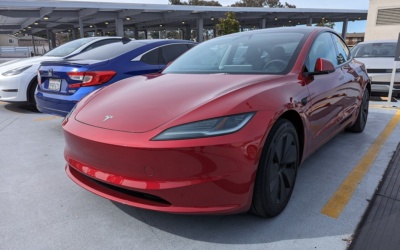
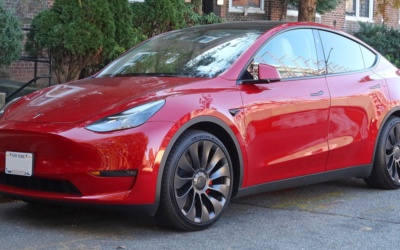
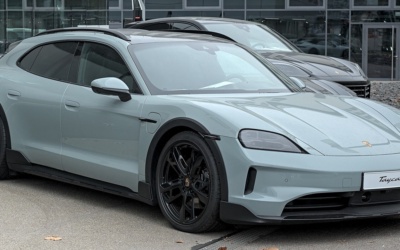
Dubai promotes electric vehicles as part of its emissions strategy: green plates, registration incentives, free parking in designated bays and an extensive DEWA charging network. Tesla opened its Dubai showroom in 2017, and today the Model 3 and Model Y are among the emirate's best-selling cars. They reached rental fleets a few years ago, and we now run more than ten electric models.
Main models in the fleet
| Car | Range | 0–100 km/h | Seats | Per day, AED |
|---|---|---|---|---|
| Tesla Model 3 | up to 500 km | 6.1 s | 5 | 250 |
| Tesla Model Y | up to 450 km | 6.9 s | 5 | 350 |
| Tesla Model X | up to 500 km | 3.9 s | 6 | 700 |
| Porsche Taycan | up to 450 km | 4.8 s | 4 | 1,000 |
Cars are handed over at 90 percent charge or above and can be returned at any level. There is a AED 100 charge if you return below 20 percent, since the car has to be prepared for the next client.
Where to charge
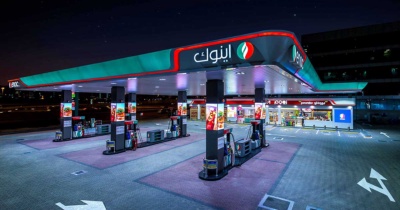
The DEWA EV Green Charger network. Over 700 stations across Dubai: at ENOC petrol stations, in malls, by metro stations, at hotels and in residential complexes. Payment through the DEWA app or a station card, at around AED 1.2 per kilowatt-hour on fast chargers. A full charge of a Tesla Model 3 costs about AED 70 against AED 150 of petrol for the same distance.
Tesla Superchargers. At around ten locations: Dubai Mall, Mall of the Emirates, Marina Mall, Dubai Hills Mall, City Walk and on the highway towards Abu Dhabi. Charging from 10 to 80 percent takes 25 minutes. Payment is tied to the car's account and we add it to your invoice as incurred.
Slow charging. Three hours of shopping in a mall adds 100 to 150 km. That is enough to stop planning charging separately: it happens alongside everything else.
The Porsche Taycan needs DEWA or ADNOC fast chargers of 150 kW or more; standard 22 kW units are too slow for it.
Will the range cover Abu Dhabi
From the Marina to the Grand Mosque is 130 km, and the same back, so 260 km plus city driving. On a full charge a Model 3 or Model Y handles this comfortably. But bear in mind that air conditioning in forty-degree heat takes 15 to 20 percent of the range, and cruising at 140 on the highway consumes noticeably more than 60 in town. So top up in Abu Dhabi at the Louvre, on Yas Island or in any mall while you are sightseeing. The same applies to Hatta and Al Ain. Longer east coast loops of 350 km should be planned with one mandatory charging stop.
Advantages
- Fuel costs half as much: AED 70 against AED 150 for the same distance.
- A silent cabin with no vibration, which you notice in traffic.
- Air conditioning runs without the engine, so you can wait in the car as long as you like without burning fuel or breaking idling rules.
- Autopilot on the highway reduces fatigue on long stretches.
- Charging bays at malls are usually closer to the entrance.
- Instant torque from a standstill, which is more useful in Dubai traffic than top speed.
Drawbacks
- You need to plan charging at least every second day, and more often in the heat.
- In high season popular mall chargers can have a 20 to 30 minute queue.
- A Tesla takes getting used to: no instrument panel in front of the driver, everything through the central screen, flush door handles and the gear selector on screen. We spend the first ten minutes showing you at handover.
- The rental threshold is the same as for every other car: 21 years old with one year of experience.
- For a monthly rental you need charging at home or at your hotel, and not every residential complex has it.
Who it suits
People driving around the city and on day trips, staying in a hotel or apartment with parking chargers, who want to try a Tesla without buying one. People who value silence and dislike petrol stations. People here for a month who count costs: the fuel saving over 3,000 km is around AED 480.
For touring all the emirates in a short time, or for a single-day run into the mountains and the east coast, a petrol car or hybrid is safer: chargers there are fewer and rarely fast.
What to check at handover
- The charge level and the estimated range on screen.
- That the charging cable and a Type 2 adapter are in the boot.
- The DEWA network app or access card, which we hand over with the key.
- How the doors open from outside and inside: on a Tesla this is not obvious, especially the rear ones.
- Where the charge port release button is.
Practical details
The Tesla app is not linked to a rental car, so control is through the screen and the key card only. Regenerative braking is strong, meaning you barely touch the brake pedal, and you adapt within half an hour. In summer plug in as soon as you arrive at a mall rather than on the way out: more bays are free in the morning. Use the car's own navigation, which suggests charging points along your route and calculates your arrival charge.
The charging map in practice
The DEWA Smart app shows every station on the network with its live status: free, occupied or out of service. That is the primary tool. The Tesla app shows Superchargers and hotel Destination Chargers.
Where chargers are almost guaranteed: all major malls (Dubai Mall, Mall of the Emirates, Marina Mall, Ibn Battuta, Dubai Hills, City Centre), ENOC and EPPCO stations with green EV markings, metro station car parks, most five-star hotels, DIFC and Business Bay office towers, and government building car parks.
Where they are scarce or absent: the older districts of Deira and Bur Dubai, beach car parks, desert roads, inter-emirate highways apart from major service areas, and Hatta and the mountain routes.
The practical approach: charge opportunistically wherever you are stopping for an hour or more anyway. In Dubai you almost never need to make a dedicated trip to a charger.
Electric cars in the heat
Summer heat affects an electric car more than a petrol one. Air conditioning draws 2 to 4 kilowatts, taking 15 to 25 percent off your range in city driving. At 45 degrees the battery runs less efficiently and charges more slowly: a 10 to 80 percent fast charge takes 30 to 35 minutes in summer instead of 25.
The practical conclusions: budget 20 percent below the quoted range in summer, do not leave the car in the sun below 20 percent charge, and use pre-conditioning from the screen before you head out, which runs off the grid while plugged in and does not consume range.
One advantage of the heat: the battery needs no warming as it would in a European winter, so full power is available immediately.
Who an electric car does not suit
- Anyone planning to cover all the emirates in two or three days: chargers on highways and in the mountains are scarce.
- Anyone staying in an apartment with no parking charger who would rather not make separate charging trips.
- Anyone heading into the desert to camp or to remote beaches.
- Anyone who would rather not learn a new interface on holiday: a Tesla is operated fundamentally differently.
For city driving, day trips and monthly rentals with charging at home it is an excellent choice with genuine savings.
Driving a Tesla for the first time: the ten-minute briefing
A Tesla differs from a conventional car enough that we always demonstrate the basics at handover. The key points.
- The key: a key card tapped against the pillar between the doors. A phone works as a key through the app, but the app cannot be linked to a rental car.
- Doors: from outside, press the wide part of the handle and pull the protruding end. From inside there is a button on the armrest rather than a lever. A mechanical lever exists but is only used with a flat battery.
- Starting: there is no start button; the car is ready when you sit down with the key. The gear selector is on the screen or a column stalk depending on model.
- Braking: regeneration is strong and the car slows firmly when you lift off. The brake pedal is rarely needed and you adapt within half an hour.
- Everything else on the screen: mirrors, steering column, climate, lights, boot and charge port. Physical buttons barely exist.
- Autopilot: engaged with a double pull of the stalk. It holds the lane and distance, but hands must stay on the wheel.
The monthly economics of an electric car
| Item | Tesla Model 3 | Toyota Corolla |
|---|---|---|
| Monthly rental | AED 5,000 | AED 2,850 |
| Energy or fuel, 3,000 km | AED 420 | AED 900 |
| Total | AED 5,420 | AED 3,750 |
The fuel saving is real but does not cover the difference in rate: an electric car remains a choice for those who want the experience, the silence and the technology rather than a saving. That said, a Model 3 belongs to a different class in performance and equipment, so the fairer comparison is with a premium sedan, where the price difference works in its favour.