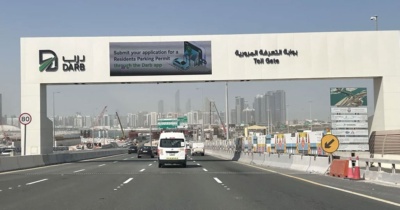
Salik operates in Dubai only. Abu Dhabi has run its own toll system, Darb, since January 2020, charging for entry to the island where the capital's centre sits: the Corniche, government buildings, most hotels and offices. Gantries stand on the four bridges onto the island: Sheikh Zayed, Al Maqta, Mussafah and Sheikh Khalifa, and since May 2026 two more gates work around the clock at Ghantoot on the E11 and at Al Qurm. Drive from Dubai to the Sheikh Zayed Grand Mosque or the Corniche and you cross a bridge gate; the Louvre Abu Dhabi on Saadiyat is reached from the E11 and E12 without one.
Rates
During peak hours, 7 to 9 am and 3 to 7 pm Monday to Saturday, a crossing costs AED 4. Outside peak hours the bridge gates are free. On Sundays and public holidays crossings are free on all four bridges, all day. There is no longer a daily or monthly cap (both were abolished on 1 September 2025): every peak-hour crossing costs AED 4. The Ghantoot and Al Qurm gates charge AED 4 at all hours, Sundays included.
By comparison, Dubai's Salik charges AED 4.20 to 6.30 per crossing including VAT, free from 1 to 6 am. Neither system has a daily cap now, but the Abu Dhabi bridges are free outside peak hours, so an active day with several trips on and off the island can still end up cheaper than the same amount of driving around Dubai.
How it works on a rental car
Nothing needs registering and there is no paperwork to arrange beforehand. Darb is Abu Dhabi's own system: cars from other emirates need a Darb account, and our whole fleet is registered and funded. Cameras at the gates read the plate in either direction, and the charge is billed to the registered owner, the rental company. We pass on the charges at face value, with no markup, as part of the final invoice, or monthly for longer rentals. There are no barriers, stops or tickets: you cross the gantry at the normal speed of traffic and notice nothing.
Where the gantries are
- Sheikh Zayed Bridge. The main entry from the E10 highway coming from Dubai. This is the capital's most striking bridge, designed by Zaha Hadid in the shape of a taut bow. Most tourist traffic and most navigation apps route through it.
- Al Maqta Bridge. The old historic crossing next to Sheikh Zayed, beside the restored Al Maqta Fort and its watchtower, a few minutes from the Grand Mosque. Navigation apps use it to bypass congestion on the main bridge during peak hours.
- Mussafah Bridge. The western entry from the Mussafah industrial area and the E30 highway, relevant if you are coming from the south or from Khalifa Port.
- Sheikh Khalifa Bridge. The north-eastern link between the city and Saadiyat Island with the Louvre, and on via the E12 to Yas Island with Ferrari World, the most convenient for guests staying at hotels on those islands. You pay here at peak hours when you drive between the centre and Saadiyat.
- Ghantoot gate. Since 4 May 2026, on the E11 just inside the Abu Dhabi border, one gate in each direction, AED 4 at any hour. The parallel E311 avoids it.
- Al Qurm gate. Since 4 May 2026, on Wahat Al Karama Street, AED 4 at any hour. Sheikh Rashid bin Saeed Street and Arabian Gulf Street avoid it.
Yas Island, home to Ferrari World, Warner Bros World and the Formula 1 circuit, and Saadiyat Island with the Louvre and its beaches, are reached from Dubai on the E11 and E12 without crossing an island bridge gate, but the E11 has the Ghantoot gate (AED 4 at any hour; the E311 avoids it). Driving between these islands and the city centre means crossing a bridge gate, from Saadiyat the Sheikh Khalifa Bridge.
How the charges add up in practice
You are charged for every crossing in either direction, entry and exit counted separately. Arrive on a weekday morning during peak hours and leave after 7 pm: AED 4 in on the bridge and nothing out, plus AED 4 each way at Ghantoot if you drive the E11. If you shuttle between your island hotel and the sights all day, crossing several times while hunting for parking or dodging traffic, remember there is no cap, so plan island crossings outside 7–9 am and 3–7 pm. By comparison, an active day of city driving in Dubai can easily rack up AED 30 to 40 in Salik charges.
Darb fines
A renter never receives a Darb fine: charging is automatic and happens whether you know about the system or not. Darb fines (from AED 100 for an unregistered car, AED 50 per crossing for a low balance) go to the registered owner, and our cars are registered and topped up.
The Darb app
Residents and car owners have a Darb app to view crossing history, link a payment method and pay Abu Dhabi parking fines, since the Mawaqif parking system is integrated with the same app. For a visitor on a rental car this is not necessary: everything is billed automatically through the company, and you can see the breakdown in the invoice we send.
The Dubai to Abu Dhabi road
Since 4 May 2026 the E11 has a Darb gate at Ghantoot, just inside Abu Dhabi, charging AED 4 in each direction at any hour; the parallel E311 avoids it. On the Dubai side there is the Salik gate at the exit near Jebel Ali, which belongs to Dubai's own system, not Darb. The drive takes about ninety minutes with light traffic, with limits of up to 120 km/h on the Dubai side and mostly 140 km/h on the Abu Dhabi side, and at the emirate border, roughly 60 km from Dubai, Dubai's 20 km/h speeding tolerance disappears: Abu Dhabi fines from 1 km/h over the sign. See our separate guide for a full day-trip itinerary in Abu Dhabi.
Total cost
A day in Abu Dhabi visiting four sights on the island: AED 8 for Darb at Ghantoot for the round trip plus AED 4 per bridge crossing at peak hours, and Salik at the Dubai exit and return, around AED 8.40 to 12.60. Total roughly AED 16 to 30 above fuel for the whole trip with a rental car. That is one reason a self-drive trip to Abu Dhabi is cheaper than a coach excursion, which starts at AED 250 per person.
Salik and Darb compared
| Feature | Salik (Dubai) | Darb (Abu Dhabi) |
|---|---|---|
| Cost per crossing | AED 4.20–6.30 incl. VAT, free 01:00–06:00 | AED 4 at peak (Mon to Sat 07:00–09:00 and 15:00–19:00), free off-peak; Ghantoot and Al Qurm AED 4 around the clock |
| Daily cap | none | none |
| Monthly cap | none | none |
| Free days | none (Sunday flat AED 4.20) | Sundays and public holidays on the four bridges only |
| Number of gates | 10 gates | 6 gates: 4 bridges, Ghantoot, Al Qurm |
| Registration | automatic by plate | Darb account needed for cars from other emirates; our fleet is registered |
The practical conclusion: an active day around Dubai crossing several gantries costs AED 20 to 40, whereas Darb charges only at peak hours on the bridges, but always at Ghantoot and Al Qurm. For a renter this means road costs in the capital depend mostly on when you cross, while in Dubai they depend on your route.
Where Dubai's Salik gantries are
All ten gates: Al Barsha on Sheikh Zayed Road, Al Safa North and Al Safa South near Downtown, Al Maktoum Bridge and Al Garhoud Bridge over the Creek, the Airport Tunnel, Al Mamzar North and Al Mamzar South on the Sharjah border, Jebel Ali on the Abu Dhabi exit, and Business Bay Crossing.
Routes with no gantries at all: most of Al Khail Road, Emirates Road, the internal roads of Jumeirah and the Marina, and the roads to Al Qudra and the desert. Google Maps and Waze show tolled sections and can route around them if you enable avoid tolls, although the detour usually costs more time than the toll costs money.
How this appears on your invoice
After you return the car we produce a final invoice showing Salik and Darb crossings as separate lines with the date, time and gate name for each. You see exactly what the system charged, with no rounding or markup. On long-term rentals this invoice comes monthly.
Typical road costs: a visitor staying in the Marina and driving around the city spends AED 15 to 25 a day on Salik. A trip to Abu Dhabi adds about AED 16 to 30 for the round trip. Over a week of active driving that comes to AED 120 to 200, comparable to two days of parking.
Parking in Abu Dhabi: the Mawaqif system
Besides the toll bridges, the capital operates Mawaqif paid parking, integrated with the same Darb app. Markings show the zone type: blue and white is standard paid parking, black and white is premium in the centre, and solid blue is resident-only where visitors may not park.
Rates: standard zones AED 2 an hour or AED 15 a day, premium AED 3 an hour. Payment applies 8:00 to 24:00 Monday to Saturday, with Sunday free. Pay through the Darb app or by SMS to 3009 with your plate number and zone.
The fine for non-payment is AED 200, for parking in a resident zone AED 500, and in a disabled bay AED 1,000. Camera-equipped patrol cars cruise the streets constantly.
Every major attraction has free and generous parking: the Grand Mosque, Qasr Al Watan, the Louvre, parts of the Corniche, and Yas and Saadiyat islands.
Total daily costs in Abu Dhabi with a rental car
| Item | Amount, AED |
|---|---|
| Salik leaving Dubai and returning | 8.40–12.60 |
| Darb, entry and exit | 8 at Ghantoot plus 0–8 on the bridges, no cap |
| Fuel, 280 km in a sedan | 40–50 |
| Mawaqif parking, 3–4 hours | 8–12 |
| Total above the rental | 65–90 |
For comparison: a one-way taxi from Dubai to Abu Dhabi costs AED 300 to 350, and a group tour AED 250 per person. For four people the car pays for the trip many times over.