Oman borders the UAE along its entire eastern side, and the Omani Musandam peninsula with its fjords is only two hours from Dubai, while the capital Muscat is around seven. The temptation is real: mountains, clear seas, dolphins and prices below Dubai's. But taking a rental car across a border is a matter of paperwork rather than desire, and at most companies the answer will be no.
Why rental companies refuse
Insurance issued in the UAE covers the UAE only. Abroad, any accident, however minor, means the company pays for repairs with nothing back from the insurer. The second risk is that theft or non-return of a car abroad becomes an international matter the company can rarely win. The third is that Omani police at a stop require a letter from the vehicle's owner, and without one the driver is turned back at the border and sometimes the car is held pending checks.
That is why international chains such as Hertz, Avis and Budget write the ban straight into the contract, and most local companies simply do not want the paperwork. It is still possible, however, and some companies including ours handle these trips.
What you need to arrange
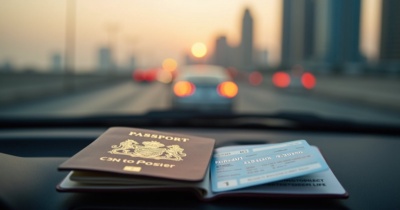
- A No Objection Certificate (NOC) from the rental company on letterhead with a stamp. It states the plate number, VIN, your passport details, licence number and the exact travel dates. Omani border officers check that every detail matches.
- Omani insurance for the car. Bought at the border from an insurance window or online in advance. A week costs AED 100 to 200. It usually covers third-party liability only, meaning damage to others' property, not to your rental car.
- A copy of the vehicle registration, the Mulkiya. Issued by the company along with the NOC; the original stays in the car.
- An Omani visa. GCC citizens need no visa. About 100 nationalities, including EU, UK and US citizens, can enter visa-free for 14 days with a return ticket, a hotel booking and health insurance, and since August 2026 Oman has also been rolling out a free 14-day tourist visa on request. Others need an e-visa, applied for on the Royal Oman Police website a few days ahead: 5 Omani rials for 10 days or 20 rials for 30 days. Rules change, so check evisa.rop.gov.om before travelling.
- A UAE exit fee of AED 35 per person at the border.
- An International Driving Permit if your licence is not recognised in Oman directly.
How it works with us
We permit trips to Oman in economy and mid-size cars on rentals of three days or more. Tell us when booking: we prepare the NOC, explain where to buy Omani insurance at the crossing and give you a contact in case of trouble. The permission fee is AED 150, covering the paperwork and the added risk. Premium cars, SUVs above AED 500 a day and all supercars are never allowed across the border under any circumstances.
Which crossings work
- Hatta – Al Wajajah. The main crossing towards Muscat and inland Oman, 130 km from Dubai. Open around the clock, usually queue-free on weekdays, but with waits of up to an hour on Thursday evenings and holidays.
- Al Dara / Tibat in Ras Al Khaimah: the only route into Musandam and the town of Khasab with its fjords. Two hours from Dubai to the crossing, then another hour along a spectacular coastal road to Khasab.
- Mezyad near Al Ain towards Omani Buraimi: convenient for the Jebel Akhdar mountains and Nizwa.
- Khatm Al Shikla and several smaller Abu Dhabi crossings, less convenient for visitors.
Note that Hatta itself is not Oman. Until 2019 the road there passed through Omani territory at Madha, which caused confusion. Today the E44 runs entirely within the UAE and Hatta requires no documents at all.
Musandam: is it worth it
Musandam is an Omani enclave cut off from the rest of the country by the emirates. The Norway of Arabia: fjords, sheer cliffs, clear water, dolphins and villages reachable only by boat. From Khasab, traditional dhow cruises run half-day and full-day trips with snorkelling stops and lunch on board, from 25 Omani rials per person. There is a mountain road up Jebel Harim with fjord views, but it is unpaved and off-limits to UAE rental cars.
A day trip is technically possible: two hours to the border, an hour to Khasab, a cruise and back. But that is twelve hours travelling and on the water. One overnight in Khasab makes far more sense; hotels there are few, so book ahead.
Muscat: do the maths differently
Muscat is about 450 km and seven hours from Dubai via the Hatta crossing. A day trip makes no sense. For a week-long trip it can work, but flying is often cheaper: Dubai to Muscat flights run several times a day, take an hour, and you can rent a car in Oman itself, where local companies hand it over with no NOC and Omani insurance already included.
What to expect on the Omani side
Traffic rules are similar but limits are lower: 120 on highways, 80 to 100 on roads, with a smaller speeding tolerance than Dubai's. Fines go to the car and then to the company, and we pass them on to you. Petrol is cheaper in Oman than in the UAE. Mobile service works on roaming, and a local SIM can be bought at the border. Alcohol may not be brought into Oman and is sold only in licensed hotels. Roads are less well lit at night, and camels and goats appear on them.
What happens if you go without permission
You will not get through the Omani border: the system checks the vehicle against a database, and a mismatch between owner and driver is immediately visible. If you somehow do get through, any accident is entirely at your cost, the rental contract is breached and the insurance is void. The company may bill you the full value of the car if it is lost. That is not a risk worth the AED 150 you saved.
The border procedure step by step
- Leaving the UAE. Approach the Emirati terminal, with passport control either in the car or on foot depending on the crossing. Pay the AED 35 exit fee per person in cash or by card. Receive an exit stamp.
- The neutral zone. A few hundred metres between the posts.
- Entering Oman. Passport control and visa check where required. UAE residents in eligible professions can get a visa at the border for 5 Omani rials; other visitors should already qualify for visa-free entry or hold an e-visa.
- Arranging vehicle insurance. An insurance window sits at the crossing itself, open around the clock at the main posts. You need the vehicle documents and the NOC. The cost is AED 100 to 200 depending on duration.
- Customs inspection. Usually cursory; they may ask about alcohol, which may not be brought into Oman.
- NOC verification. The officer checks the vehicle details in the letter against the registration card and your passport. A single mismatched digit means refusal.
The whole process takes 30 to 60 minutes on weekdays and up to two hours at weekends and holidays. The return is similar, with an added check for prohibited goods entering the UAE.
Musandam: what to see
The Musandam peninsula is called the Norway of Arabia for fjords found nowhere else in the region. The main town is Khasab, an hour from the Tibat crossing along a coastal road worth driving for its own sake: it is cut into cliffs above the sea.
The main activity is a traditional dhow cruise through the fjords: half a day or a full day, with snorkelling stops, lunch on board and dolphin watching, which almost always delivers. Prices start at 25 Omani rials per person, around AED 240. Boats leave Khasab harbour in the morning.
Also worth seeing: the 17th-century Khasab Fort, the mountain road up Jebel Harim with fjord views, though it is unpaved and off-limits to UAE rental cars, the village of Kumzar reachable only by boat, and Telegraph Island with its 19th-century British cable history.
Is driving into Oman worth it at all
The honest answer: for Musandam yes, if you are going for two or three days and can handle the formalities. For Muscat no, since flying and renting locally from an Omani company is cheaper and faster, with no NOC needed, local insurance included and knowledge of local roads.
The alternative for Musandam is an organised tour from Dubai with transfer, cruise and lunch, from AED 400 per person. You do not drive and the operator handles the formalities, but you have less freedom. For a family of four the tour costs AED 1,600, while a self-drive trip with paperwork runs about AED 1,300 over three days, including the rental, permission, insurance and visas.