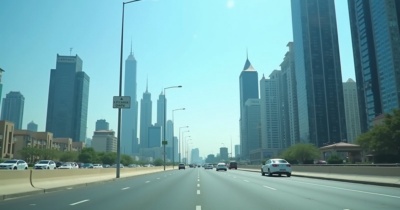
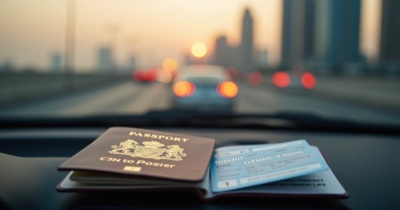
Driving in Dubai at night is easier than many visitors expect: the heat drops, traffic thins out, and the main highways and city entrances are generally lit. The risks are different ones. They are tiredness after a flight or a long day, unlit roads outside the city, and an empty highway where speed builds up without you noticing. Here is what to know if you plan evening and night trips in a rental car.
Speed limits and cameras do not sleep
When the road is empty it is easy to drift above the limit. On Sheikh Zayed Road the limit is 100 or 120 km/h depending on the section, and cameras record offences at any hour. In Dubai they typically start recording at about 21 km/h over the limit, but do not count on that margin: watch the signs and stay within the limit. Speeding fines are paid by the renter at actual cost.
There is one pleasant detail: Salik gates are free between 1:00 and 6:00. At other times in the evening the normal rates apply: AED 6.30 at peak hours (6:00 to 10:00 and 16:00 to 20:00, Monday to Saturday), AED 4.20 off peak, and a flat AED 4.20 all day on Sunday. The Salik tag is already in the car, and we invoice the actual crossings when you return it.
Headlights and visibility
After dark use dipped beam. Use high beam only on an empty, unlit road, and drop it as soon as an oncoming car appears or you close in on a car ahead. Before you drive off after sunset, ask us at handover how the lights are switched on and whether the car has automatic high beam.
In winter, mornings and evenings in Dubai can bring fog, and on windy days dust hangs in the air. In those conditions slow down, leave more distance and keep dipped beam on. If visibility is really poor, it is better to pull into a safe car park and wait than to drive blind.
Roads outside the city: camels, sand and darkness
The biggest difference on a night drive to Hatta, Al Ain or towards Al Qudra is that outside the city there is hardly any lighting. Obstacles show up late. On rural roads in the UAE camels and other animals can walk onto the tarmac, and hitting a large animal is dangerous for both the car and its passengers. On these stretches keep well below the limit, especially near fences and warning signs.
- Sand on the road. After wind, tongues of sand can lie across the tarmac and push a fast car sideways.
- Signal. In desert areas the mobile signal can drop out. Download an offline map of the area beforehand.
- Fuel. Fill up before leaving the city rather than counting on a station on the way.
- Stay on the tarmac at night. Leave the desert for daylight, and ask us before a sand trip whether your chosen car is suitable.
Driving into Oman in a rental car needs agreement in advance: ask when booking, and it is not allowed on partner cars.
Fatigue behind the wheel
At night people make mistakes less because of the dark than because of tiredness. After a flight with a time difference it is wiser not to drive straight away: take the first night to rest, or ask for the car to be delivered to your hotel so you do not hunt for it at the airport late in the evening. If you are coming back late from Hatta or the east coast, stop at a petrol station, drink some water and walk a little. Your rental includes 250 km per day, so plan a long evening route around the time it takes rather than around the mileage.
Parking at night
Parking in Dubai is paid almost everywhere from early morning to late evening, and payment is linked to your number plate through an app or a meter. The hours are printed on the sign by the bay. Many zones are free at night but not all, so read the sign. There are no paper tickets, and a fine arrives electronically. Park only in marked bays, do not block exits and keep belongings out of sight in the cabin.
A simple tip: photograph where you parked and the zone number. In a large mall car park late at night it saves time.
If something happens at night
Our office in Princess Tower, Dubai Marina, is open daily from 10:00 to 19:00. At handover ask how to reach us outside those hours and save the contacts in your phone. The car documents and the rental contract are in the glovebox and must be shown at a police check. In an emergency call the police on 999, then let us know.
Which car suits evening trips
For evening driving, look for LED headlights, a camera, adaptive cruise control and blind-spot monitoring. Prices are as of October 2026, and the current price is on each car page.
| Model | Per day, AED | Per week, AED | Per month, AED | Useful at night |
|---|---|---|---|---|
| Toyota Raize 2024 | 109 | 750 | 2,490 | LED headlights, rear-view camera |
| Toyota C-HR 2024 | 160 | 1,040 | 3,500 | LED lighting, adaptive cruise |
| Kia K5 2024 | 170 | 1,100 | 3,750 | LED headlights, blind-spot monitoring |
| Mitsubishi Outlander 2024 | 200 | 1,300 | 4,400 | 210 mm clearance, 360 camera, all-wheel drive |
| Toyota Land Cruiser Prado 2024 | 400 | 2,400 | 8,000 | 360 camera, adaptive cruise, four-wheel drive |
These cars come with no deposit and a one-day minimum rental. If the car you choose is a partner car, it may have its own terms: the deposit and minimum period are shown on its page.